Your selection
Research / 23.06.2026
ERC Advanced Grants awarded to two Berlin researchers
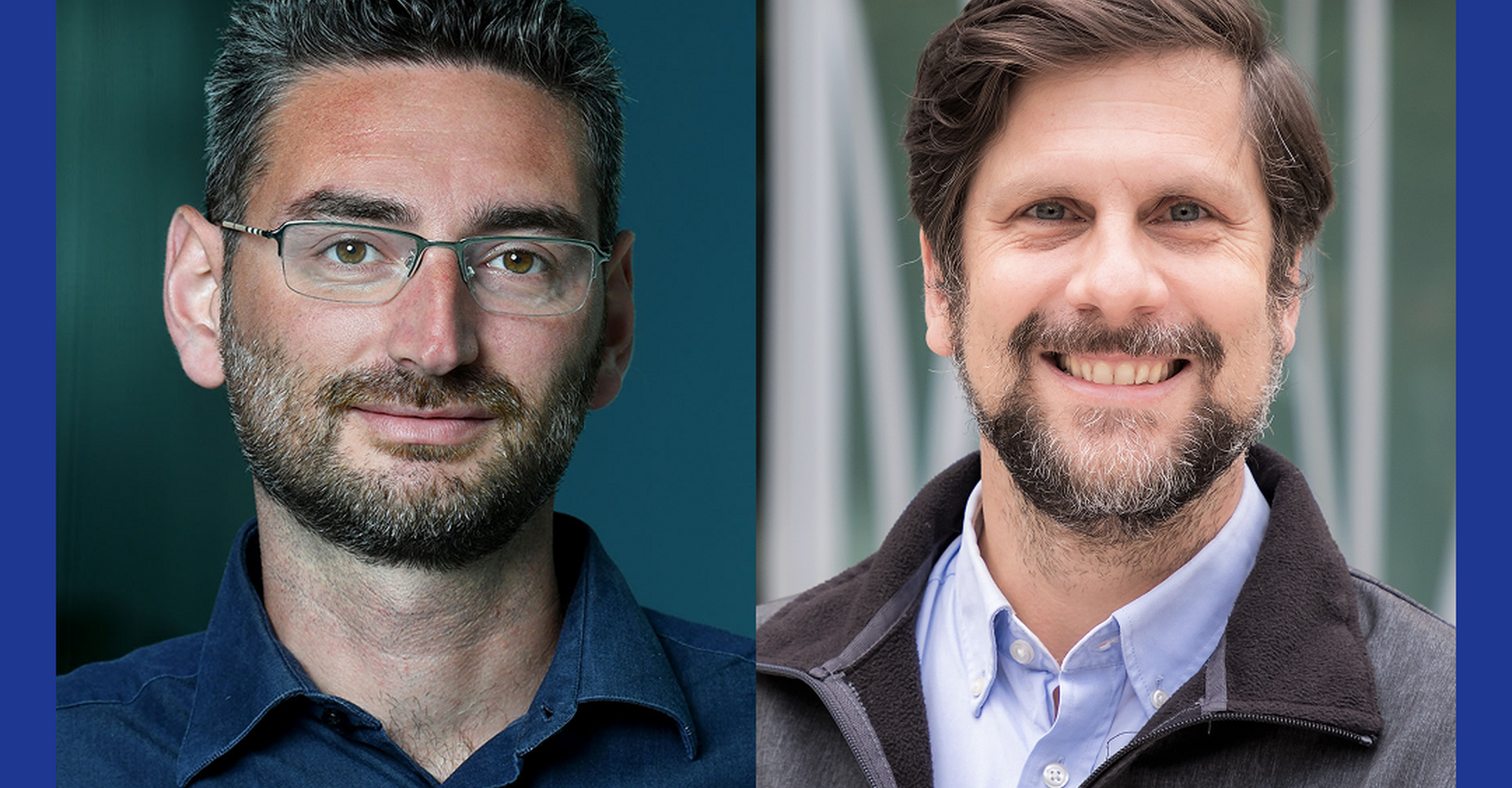
ERC Advanced Grants awarded to two Berlin researchers
Uwe Ohler and Gaetano Gargiulo have been awarded prestigious ERC Advanced Grants. With funding of €2.5 million each, they will spend the next five years investigating how protein synthesis is regulated and identifying vulnerabilities in pediatric brain tumors.
Two Max Delbrück Center scientists have secured prestigious European Research Council (ERC) Advanced Grants, one of Europe’s highest honors for established researchers: Dr. Uwe Ohler, Group Leader of the Computational Regulatory Genomics lab, and Dr. Gaetano Gargiulo, Group Leader of the Molecular Oncology lab.
The ERC supports ambitious projects by outstanding researchers who have already achieved significant success in their fields. Recipients receive up to €2.5 million over five years to pursue promising research ideas. This year only 319 researchers were selected from 3,329 who applied from across Europe.
Designing RNA with precision
Ohler won funding for project TRANS-DECODE. With his team, he will investigate how cells regulate translation — the process by which cells use the messenger RNA transcripts of our genetic material — to produce proteins. “Many genetic diseases are not caused by changes in protein-coding genes but by errors in translation,” says Ohler. “We want to better understand this finely tuned process in which regulatory regions in messenger RNA play an important role, and develop molecular tools that allow us to intervene in a more targeted way.”
The Ohler lab will combine machine learning — a type of artificial intelligence (AI) — with advanced molecular biology techniques. These methods enable researchers to measure the activity of thousands of regulatory RNA segments simultaneously, modify them in very specific ways, and generate snapshots of all proteins produced in a cell.
The team will use explainable AI (XAI) to find regulatory elements hidden within messenger RNA and to understand how manipulating them affects translation. “With XAI, we can ensure that the models’ predictions remain transparent and understandable to us,” explains Ohler. For their experiments, the researchers will use both human cells and zebrafish, which serve as a vertebrate model.
“With TRANS-DECODE, we not only want to unravel the molecular logic of translation step by step, we also want to identify new ways to correct defects in regulatory RNA segments that contribute to human disease,” says Ohler. “Our long-term goal is to rationally design RNA molecules for both therapeutic and synthetic biology applications, such as developing better vaccines.”
Avatars of brain tumors
Gargiulo will use his grant to create highly realistic models of pediatric brain tumors in a project called MOIRA. He and his team plan to replicate in detail the transformation of a healthy, maturing brain cell into a tumor cell within a brain organoid — a type of miniature organ. These tumor avatars will help his team better understand how these cancers develop and identify potential treatment strategies.
The grant marks Gargiulo’s fourth ERC award. He won a Starting Grant in 2016, which he used to begin creating models of brain tumors. This was followed by two Proof of Concept grants in 2022 and 2024 that helped his team further develop a new technology called synthetic genetic tracing. The method uses artificial DNA molecules, called reporter genes, to visualize specific cellular activities within tissues.
In MOIRA, these two fields of research are now being brought together: Gargiulo and his colleagues aim to develop reporter genes that turn on as soon as a cell activates a tumor-like program. “In human brain organoids, the reporter genes will help us determine which cells exhibit characteristics of brain tumors, which type of brain tumor they resemble, and when these changes occur,” explains Gargiulo. His team plans to purify the cells and use them to develop models that, step by step, increasingly resemble a real tumor. The project will combine synthetic biology with organoid research and AI-supported validation.
“With MOIRA, we want to reconstruct exactly how pediatric brain tumors arise,” says Gargiulo. “If we succeed in creating faithful tumor avatars, we can say that we have truly come much closer to understanding these diseases. In addition, our models will allow us to systematically search for tumor vulnerabilities — and thus identify potential targets for new drugs.”
Text: Anke Brodmerkel
Further information
Computational Regulatory Genomics
Photo left side: Gaetano Gargiulo © David Ausserhofer, Max Delbrück Center
Photo right side: © Felix Petermann, Max Delbrück Center
Overview News
News Buch Berlin
A Leap into the World of Big Pharma
The Successful Transformation of a Startup: An Interview with Dr. Christian Regenbrecht, Vice President of Translational Oncology at GSK and Founder of CELLphenomics
more ...Alithea Bio Scores Double Victory at VivaTech 2026 for Breakthrough in Preclinical Safety
Deep-tech biotech innovator Alithea Bio has achieved a spectacular double victory at VivaTech 2026, Europe’s largest startup and tech event, taking home both the coveted “Tech for Change” Jury Prize a...
more ...Eckert & Ziegler SE Annual General Meeting Approves Significantly Higher Dividend
The Annual General Meeting of Eckert & Ziegler SE (ISIN DE0005659700) today approved the proposal of the Executive Board and Supervisory Board and resolved to pay a dividend of € 0.22 per share (previ...
more ...Events Buch Berlin
27.08.2026, 10:00
CRISPR/Cas: Grundlagen und praktische Anwendung (Verschoben vom 4. Juni auf 27. August)
Der Crashkurs für Einsteiger*innen vermittelt die Grundlagen der CRISPR/Cas Technologie. Die Teilnehmer*innen sollen in die Lage versetzt werden, CRISPR/Cas Experimente selbständig zu planen und durch...
more ...22.09.2026, 09:00
GMP Biotech Summer School
Knowing and applying the Good Manufacturing Practice (GMP) regulations is one of the key elements in the manufacture of medicinal products for clinical trials and on an industrial level.
more ...09.11.2026, 09:00
Fachkraft für Molekularbiologie
Elftägiges Intensivseminar der Berlin BioScience Academy. Es rmittelt Grundlagenwissen zu den wichtigsten Labormethoden der modernen Molekularbiologie und vermittelt Einblicke in die klinische Forschu...
more ...